
Two people type the same request into the same AI tool. One gets a sharp, usable paragraph. The other gets waffle. The difference is rarely luck and almost never the tool — it is the prompt. Prompting is a learnable skill with a handful of reliable principles, and the good news is that none of them require technical knowledge. This guide teaches the craft through writing tasks specifically: emails, articles, summaries, and social posts.
Why vague prompts produce vague writing
An AI writing assistant has no idea what you want beyond what you type. “Write about productivity” contains no audience, no length, no tone, no purpose — so the model fills every gap with the most average choice available, and average is exactly what you get back. The model is not being lazy; it is doing statistics on an underspecified request, as explained in how ChatGPT actually works. Every improvement in prompting is really an act of removing ambiguity: the clearer your instructions, the fewer gaps the model has to guess at, and the less generic filler you have to delete afterwards.
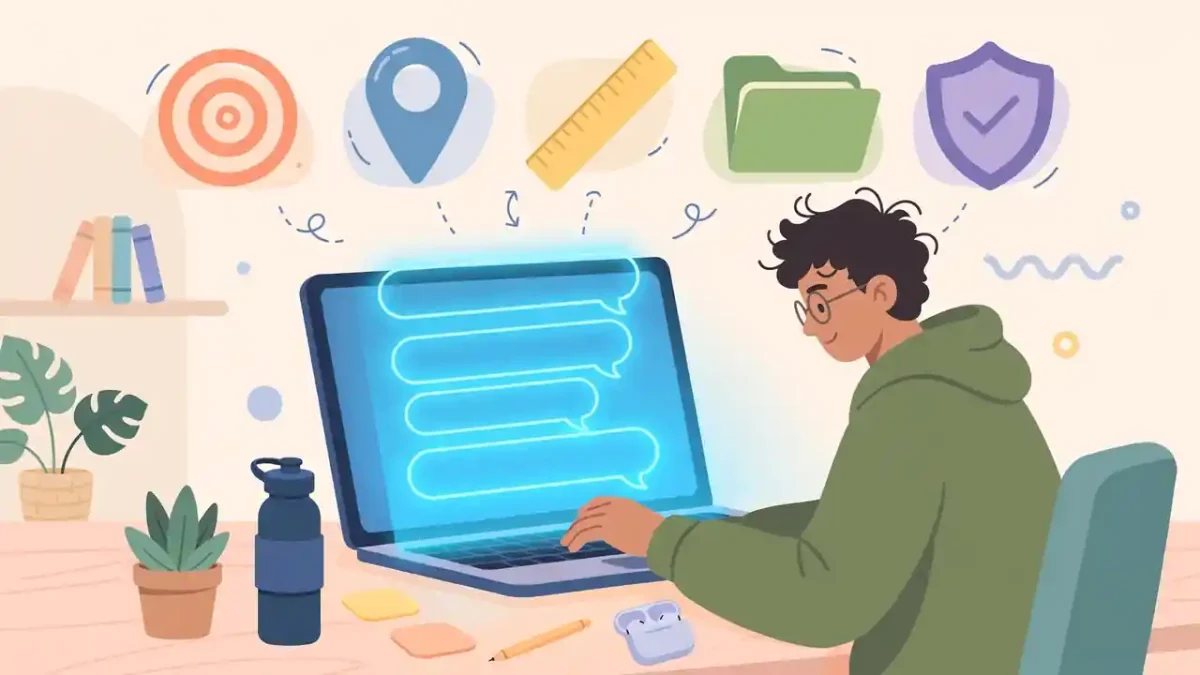
The five ingredients of a strong writing prompt
- Task. Say the exact job: draft, rewrite, shorten, expand, summarise, translate, or brainstorm. Verbs matter — “rewrite” and “write” produce different behaviour.
- Context. Who is this for, why does it exist, what happened before? Two sentences of background routinely double output quality.
- Specifications. Length, format, tone, structure. “Three short paragraphs, friendly but professional, ending with a question” is a specification the model can actually hit.
- Material. Paste the notes, draft, data, or source text. Writing grounded in your material beats writing invented from the model’s memory every time — and invents less, a point that matters given why AI hallucinations happen.
- Constraints. Say what to avoid: no jargon, no clichés, no exclamation marks, do not mention price. Models follow explicit prohibitions better than vague hopes.
Worked example: watch a weak prompt become a strong one
Suppose you need an email postponing a meeting. The weak version: “Write an email to postpone a meeting.” The result will be a bland template with bracketed blanks. Now the strengthened version: “Draft a short email to a client postponing our Tuesday project meeting to next week because the supplier’s report is delayed. Apologetic but not grovelling, under 120 words, propose Thursday 10 a.m. as the alternative, and end by confirming everything else stays on track.” Same tool, same minute of effort — but now the model has a task, facts, a tone, a length, and a structure. The output will need light editing instead of a rewrite. Specialised cases go further still; AI email writers — what they do well and badly shows where even great prompts hit the category’s limits.
Iterate like an editor, not a slot machine
The most common beginner mistake is regenerating the whole answer hoping for a better roll of the dice. Professionals treat the first output as raw material and direct revisions: “Make paragraph two warmer.” “Cut this to half the length.” “Give me three alternative opening lines.” Each instruction is small, specific, and cumulative — exactly how a human editor works with a writer. Related techniques compound the effect:
- Ask for options, then choose. “Give me five headline ideas” produces better headlines than “give me a headline,” because selection is where your taste earns its keep.
- Provide a style sample. Paste a paragraph of your own writing and ask the model to match its rhythm and vocabulary. This is the fastest route out of generic AI voice.
- Assign a perspective carefully. “Explain this as a patient teacher would” works because the model has strong patterns for registers and roles. Keep it honest — a persona changes style, not knowledge.
- Outline first, prose second. Approve a structure before asking for paragraphs and the long output stays coherent instead of wandering.
Mistakes that quietly ruin otherwise good prompts
Burying the actual request under pages of pasted material, with no instruction about what to do with it. Asking for everything at once — an article, its headline, its social posts, and its summary in one breath — which guarantees each part gets shallow treatment. Contradictory instructions, like “detailed but under fifty words.” Assuming the model remembers a previous chat or your unstated preferences. And the classic: accepting the first draft as final. Prompting well gets you a better draft faster; it does not repeal the editing stage. If prompting starts to feel like a real, nameable skill, that is because it is — prompt engineering explained looks at how far that idea goes professionally.
A starter routine you can reuse today
Save this pattern and adapt it: “You are helping me write [thing] for [audience]. Goal: [outcome]. Use this material: [paste]. Format: [structure, length]. Tone: [two or three adjectives]. Avoid: [constraints]. First give me an outline; wait for my approval before drafting.” Run it three times on real tasks and you will feel the difference immediately — not because the formula is magic, but because it forces every ingredient above into one message. From there, keep a small personal library of prompts that worked. Reusing your own proven prompts is the unglamorous secret behind most “AI productivity” stories, whatever tool you use — and most leading writing tools offer a free tier to practise on, though prices and features change, so check the official site before committing to a plan.
Prompts for the four jobs you will do most
Concrete patterns beat theory, so here are skeletons for the requests beginners make most. For a summary: “Summarise the text below in five bullet points for a busy manager. Keep names, dates, and numbers exact. If something is unclear, flag it instead of guessing.” For a rewrite: “Rewrite this paragraph for a general audience. Halve the length, drop the jargon, keep the final sentence as the closing line.” For brainstorming: “Give me ten angles for an article about [topic] aimed at [audience]. Mix practical, surprising, and personal angles. One line each.” For a draft from notes: “Turn these rough notes into a first draft of [thing], about [length], in a [tone] tone. Follow the notes’ order. Mark with [CHECK] anywhere you had to invent a detail so I can fix it.” That last instruction — asking the model to flag its inventions — is a small prompt-engineering trick with outsized value, because it converts silent guesswork into a to-do list. Adapt any of these to your own work, save the versions that succeed, and your prompts will keep improving through use rather than through study. That library, more than any single technique, is what separates people who “tried AI and it was mediocre” from people who quietly get an hour back every day.
Frequently asked questions
Do longer prompts always work better? No. Relevant detail helps; rambling dilutes. A focused 80-word brief usually beats a 400-word one stuffed with repetition and contradictions.
Should I be polite to the AI? Politeness does not change the mathematics, but clarity does. Write prompts the way you would brief a capable colleague: direct, specific, complete.
Why did the same prompt give a worse answer today? Models get updated, and outputs involve some randomness. Save good outputs when you get them, and keep your best prompts written down rather than trusting the tool to stay identical.
