
Your spam filter and ChatGPT are both called “artificial intelligence” — as are your bank’s fraud detector and the app that turns selfies into paintings. But those systems have almost nothing in common under the hood. Calling them all “AI” is like calling both a bicycle and a cargo ship “vehicles”: technically true, nearly useless.
The distinction that actually matters today is between traditional AI (sometimes called predictive or discriminative AI) and generative AI. One is built to analyze and decide; the other is built to create. They are trained differently, they fail differently, and they are useful for completely different jobs. Once you can tell them apart, most AI headlines suddenly make a lot more sense.
The one-line difference
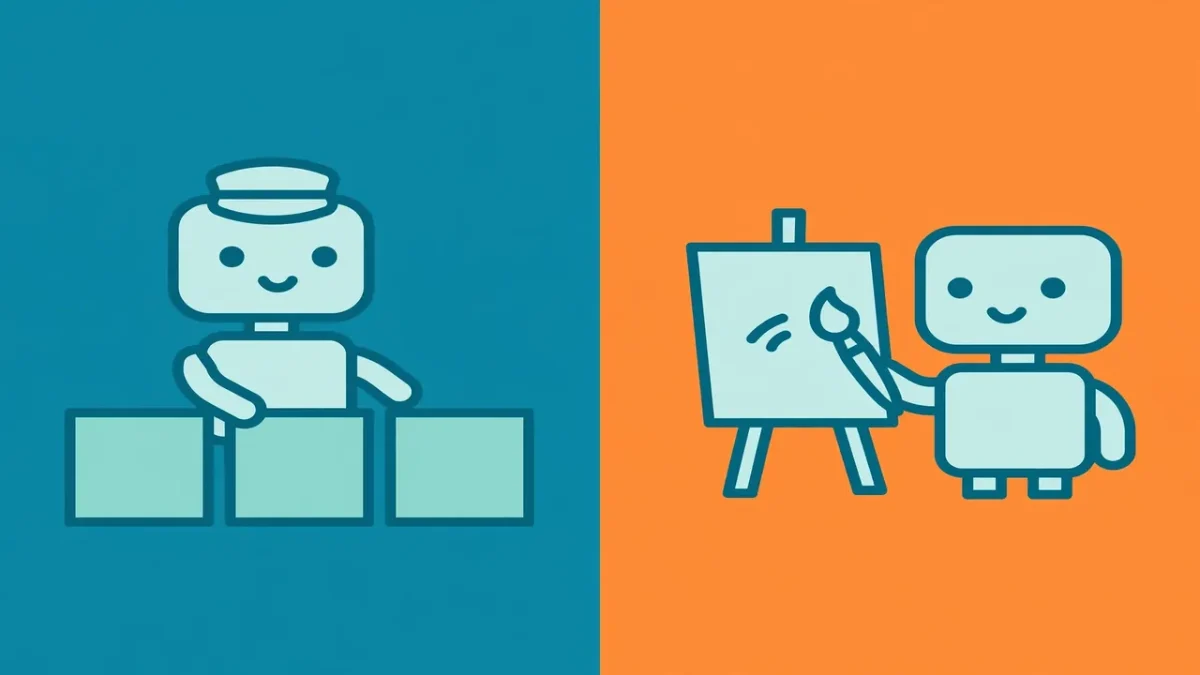
Traditional AI answers questions about data: is this email spam? Is this transaction fraud? Which of these photos contains a cat? It takes an input, finds patterns it learned during training, and produces a judgment — a label, a score, a yes-or-no. Generative AI, by contrast, produces new content: write me a poem, paint me a picture, compose me a song. It takes a prompt and creates something that did not exist before.
Another way to put it: traditional AI is a classifier — it sorts the world into categories. Generative AI is an imitator and improviser — it learned the patterns of human writing, images, or music so deeply that it can continue them in new ways. Both learn from data. What they learn to do with data is opposite.
Traditional AI: the pattern-matching workhorse
You have been using traditional AI for years without noticing. When your email sorts junk into the spam folder, that is a traditional AI model that learned which combinations of words, senders, and links tend to signal spam. When your phone unlocks with your face, a model compares the geometry of your face against the stored pattern. When a streaming service recommends a movie, a model predicts what you are likely to watch based on patterns in your history and that of similar viewers.
These systems are typically narrow and reliable. A spam filter does one job, and it does it with measurable accuracy — engineers can test it on thousands of emails and report exactly how often it is right. That testability is traditional AI’s great strength. Its great weakness is rigidity: a spam filter cannot write you an essay, and a fraud detector cannot explain itself in plain language. Ask it anything outside its training, and it fails — often silently.
Training these models looks like school with an answer key. Engineers show the model thousands of examples, each labeled: “spam,” “not spam,” “spam,” “not spam.” The model adjusts itself until it can label new, unseen examples correctly. This approach — learning from labeled examples — is why traditional AI is sometimes called supervised learning, and it powered nearly all the practical AI of the 2000s and 2010s.
Generative AI: the pattern-completing improviser
Generative AI trains differently. Instead of labeled examples, it studies enormous piles of unlabeled content — text, images, audio — and learns the underlying patterns: how sentences flow, how faces are structured, how melodies resolve. Then it learns to continue or reconstruct those patterns, generating new material that follows the same rules. ChatGPT predicts the next word; image generators start from visual noise and gradually refine it into a picture matching your description.
The results feel magical because creation is the most human-seeming thing a machine can do. But the trade-off is reliability. A traditional AI spam filter can tell you its accuracy to two decimal places. A generative model cannot — its output is new every time, and “correctness” is often a matter of judgment. That is why generative AI is brilliant at drafts, ideas, art, and conversation, and risky for anything requiring verified facts. If you want the full picture of the most famous generative system, read our plain-English explainer on what ChatGPT is and how large language models work.
A simple analogy: the librarian and the novelist
Imagine two brilliant employees. The librarian (traditional AI) has memorized where every book sits. Ask where the books on gardening are, and she points instantly and accurately. Ask her to write you a novel, and she stares blankly — that is not her job. The novelist (generative AI) has read every book in the library and absorbed how stories work. Ask him to write a gardening mystery and he produces twenty pages by morning. Ask him exactly where the gardening section is, and he might confidently invent a wrong aisle — he is a storyteller, not an index.
This analogy also explains their failure modes. The librarian’s failures are measurable: she mis-shelves 2% of books. The novelist’s failures are creative: he invents plausible-sounding details, which in AI terms we call hallucinations. Neither failure mode is “worse” in the abstract — but you must know which kind of employee you are dealing with before trusting its output.
Where each one shines in real life
Traditional AI runs quietly inside the tools you already trust: email spam filters, phone face unlock, fraud alerts from your bank, autocorrect, recommendation feeds, medical image screening that flags suspicious scans for a doctor’s review, and the voice recognition that turns your speech into text. These are judgment tasks — sort, detect, predict — and traditional AI does them tirelessly and consistently.
Generative AI shines at creation and transformation: drafting emails and essays, summarizing long documents, writing code, translating languages, generating images from descriptions, composing music, and holding natural conversations. Notice the pattern — every one of these produces new content. For hands-on ideas of what to actually do with these tools, our roundup of practical everyday uses of AI assistants is a good next read.
The blurred middle: most real products use both
The most useful AI products are hybrids. Your phone’s camera uses traditional AI to detect faces and judge focus, then generative AI to enhance the photo — the pipeline we describe in how AI photo editing really works on your phone. Chatbots classify your intent with one system and write the reply with another. The trend is not “generative replaces traditional” — it is both, each doing what it does best.
Myths worth dropping
- “Generative AI is just a better version of traditional AI.” No — it is a different species optimized for a different goal. A novelist is not a “better librarian,” and judging one by the other’s yardstick misses the point.
- “Traditional AI is obsolete now.” Far from it. Most AI running in the world today — fraud detection, spam filtering, recommendations, logistics — is traditional AI: quieter, cheaper, easier to test, and more reliable for decisions. Generative AI gets the headlines; traditional AI does most of the work.
- “Generative AI understands, traditional AI just calculates.” Both are pattern-matching machines without human understanding. Generative models just match richer patterns — rich enough to convincingly simulate understanding, which is why their mistakes are more dangerous.
So the next time someone says “AI did this,” ask the useful question: which kind? Sorting and judging, or creating and improvising? The answer tells you how much to trust it and where it will let you down. That distinction is the beginning of AI literacy.