Someone gives you a bonsai for your birthday. A beautiful little tree in a shallow blue pot, moss on the soil, branches twisting like a tiny ancient oak. You put it on your desk, admire it for a week, water it when you remember — and two months later it is a sad bundle of brown twigs. If this sounds familiar, welcome to the club. Almost everyone kills their first bonsai, because nobody tells you the truth up front: bonsai is not a decoration. It is a living tree, and living trees have opinions.
The good news is that keeping a bonsai alive is genuinely easy once you understand what it needs. Not complicated — just specific. Once your first tree survives a full year under your care, you will have a hobby that rewards patience like nothing else.
Bonsai Is Not a Species — It Is a Technique
This is the first thing most beginners get wrong. “Bonsai” is not a type of tree. It is a set of techniques — pruning, root restriction, careful watering — applied to ordinary trees to keep them small and shape them into living sculptures. That means your bonsai is still a juniper, a ficus, an elm, or a maple, with the same needs as its full-sized cousins.
Why does this matter? Because every care decision follows from the species, not the pot. An outdoor juniper on a sunny balcony will thrive for decades; the same tree on a bedroom shelf will die in weeks. Match the tree to your living conditions, not the other way around.
Why This Hobby Is Worth the Slow Burn
Bonsai is the opposite of instant gratification, and that is precisely its appeal. Ten minutes of watering and observation in the morning becomes a ritual that steadies the whole day. It is affordable, fits on a windowsill, and a tree you pinched back as a sapling slowly becomes a landscape carved from time itself.
Choosing a First Tree That Will Survive You
Do not buy the prettiest tree in the shop. Buy the toughest one. Three species stand head and shoulders above the rest for beginners:
- Chinese elm: the classic beginner tree. Forgiving of watering mistakes, tolerates indoor conditions, recovers fast from pruning errors. Ideal for apartments.
- Ficus: the most bulletproof indoor bonsai. Loves warmth and bright indirect light, bounces back from neglect, grows fast enough that you see real progress.
- Juniper: the tree most people picture when they think of bonsai. Hardier and more dramatic, but strictly outdoor — it needs winter dormancy and full sun. Only if you have a balcony or garden spot.
Buy from a nursery or a dedicated bonsai grower, not a mall kiosk. A healthy starter costs roughly $25–$60, with firm leaves or needles, no brown patches, and soil that is neither rock-hard nor soggy. If the tree is glued into the pot with decorative stones, walk away — that is decoration, not horticulture.
The Honest Starter Kit
You need far less gear than the internet suggests:
- A healthy starter tree: $25–$60
- Well-draining bonsai soil (pre-mixed bonsai soil is fine): $10–$15
- A watering can with a fine rose head, or a gentle spray bottle: $8–$12
- Basic pruning shears or sharp scissors: $10–$18
- Liquid bonsai fertilizer: $8–$12
Realistic total: $60–$115.
Watering: The One Skill That Decides Everything
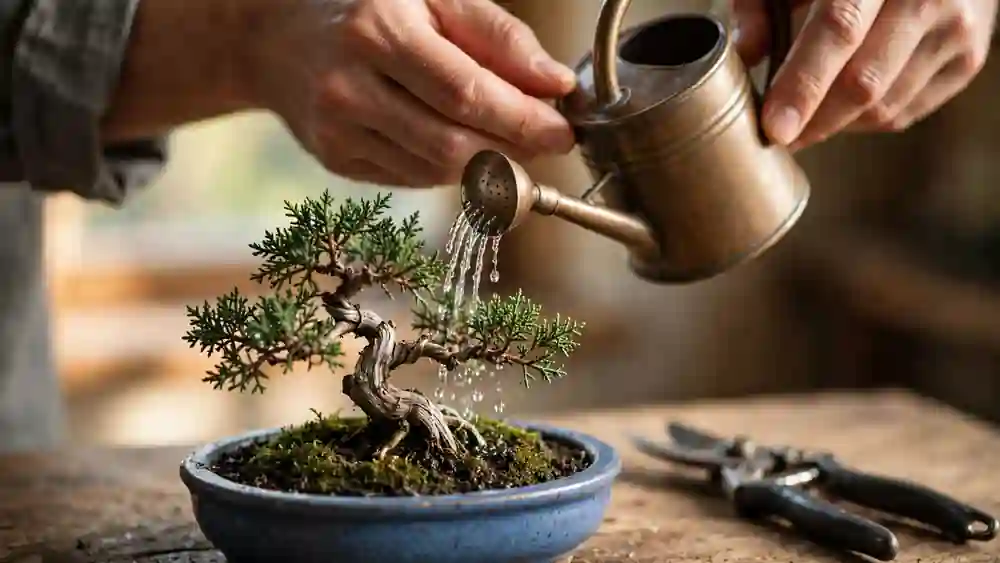
Ask any bonsai club what kills first trees, and they answer in unison: watering. Too much rots the roots; too little desiccates them. The shallow pot dries out faster than a houseplant pot, so the rules you know from caring for indoor plants need adjusting — bonsai soil can go from moist to dry in a single hot day.
Your daily routine for the first month:
- Check every morning. Push a fingertip half an inch into the soil. Moist? Leave it. Dry? Water.
- Water thoroughly. Pour gently until water runs freely from the drainage holes, then stop. A light sprinkle wets only the top — worse than nothing.
- Never leave the pot sitting in a saucer of water. Roots that sit wet will rot, and symptoms appear weeks after the damage.
- Adjust for weather. An outdoor juniper in summer heat may need watering twice a day; an indoor ficus in winter every three days. The finger test beats any schedule.
Beginners coming from container gardening have a real head start — the same rules about free-draining soil and never letting pots waterlog apply exactly, just in miniature.
Your First Pruning: A Haircut, Not Surgery
Once your tree has settled in for two to three weeks, it is time for your first pruning. Do not be afraid: a healthy beginner species recovers enthusiastically from a light trim.
- Wait for active growth. Spring or early summer is ideal; the tree heals fastest while growing.
- Step back and look. Find branches that cross over each other, grow straight up, or stick out of the silhouette. You are removing a third of the new growth, not half the tree.
- Cut just above a leaf or bud, at a slight angle, with sharp shears. Clean cuts heal; crushed stems invite disease.
- Pinch new shoots between your fingers as they grow too long. Regular pinching keeps foliage dense — this is 90% of bonsai technique for the first year.
If you grow kitchen herbs, the habit transfers directly — harvesting herbs teaches you the same pinch-back-to-a-bud discipline, just with tastier results.
5 Beginner Mistakes That Kill Trees
- Keeping an outdoor tree indoors. Junipers, pines, and maples need real seasons and direct sun. They slowly starve on a desk.
- Misting instead of watering. A daily spritz does almost nothing for the roots. Water the soil, properly, when it needs it.
- Repotting too soon. Your tree needs at least one full year in its pot before you disturb the roots.
- Fertilizing a stressed tree. Fertilizer is food for healthy, growing trees — not medicine for struggling ones.
- Leaving wire on too long. Wire left for months cuts into growing bark and scars the tree permanently. Check it monthly.
Finding Bonsai People Near You
Bonsai is one of those hobbies where a local club accelerates you by years. Most cities have a bonsai society that meets monthly, and beginners are the most welcome people in the room — experienced growers love repotting someone else’s tree and explaining every step.
Keep Reading
- Indoor Plants for Beginners: 15 Houseplants That Actually Survive Busy Homes
- Container Gardening for Beginners: Grow Fresh Food in Small Spaces This Season
- Herb Gardening for Beginners: Grow Fresh Herbs at Home and Save Money Easily
- How to Start a Vegetable Garden from Scratch: A Complete Beginner’s Guide
Bonsai Questions, Answered
How long do bonsai trees live? Decades, easily — centuries in the best cases. Your beginner tree is not a disposable craft project; with basic care it can outlive your mortgage.
Can I grow one from seed? Technically yes, but it takes five to ten years before you have anything tree-like. Start with nursery stock and practice the care skills first.
Do outdoor bonsai need winter cold? Yes — outdoor species need winter dormancy. A cold frame, unheated garage, or sheltered balcony spot works. Indoor species like ficus stay inside year-round, away from cold drafts.
How often should I fertilize? During the growing season, diluted liquid fertilizer every two weeks is plenty. Ease off in winter when growth slows.
The tree on your desk does not need perfection. It needs consistency — water when the soil is dry, light every day, a little pruning now and then. Master those three things and your first tree will still be alive years from now, slowly becoming something beautiful.