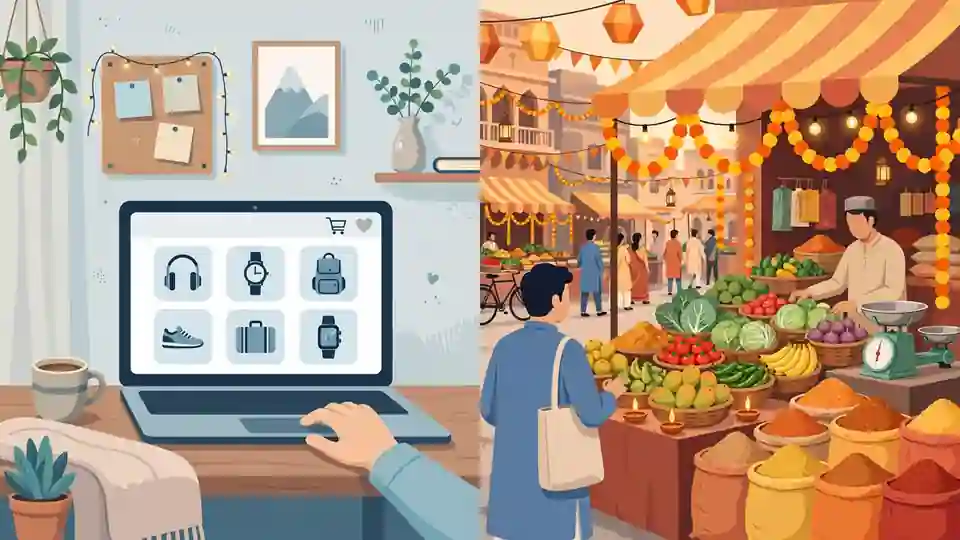
It is the week before the big festival, and you need a new phone, gifts for six relatives, and a set of curtains. Your thumb hovers over the shopping app — free delivery, instant discounts, no traffic. But your mother insists the neighbourhood market is cheaper for some things, and last year the online “deal” on a mixer arrived after the festival ended. So which is actually better during festivals: the app or the shop down the road? The honest answer is that each wins different battles, and smart festive shoppers use both.
The quick verdict
Online shopping wins on price transparency, variety, and big-ticket electronics during festive sales. Local stores win on immediacy, inspection, and anything where fit, feel, or freshness matters — clothes, jewellery, sweets, and last-minute needs. For most households, the best strategy is a split: research and buy standardized products online, and buy sensory products — things you need to touch, try, or taste — locally. Neither side is always cheaper, and anyone who tells you one always wins is selling you something.
| Criteria | Online shopping | Local stores |
|---|---|---|
| Festive discounts | Deep, advertised discounts on electronics and appliances; easy to compare across sellers | Modest discounts, but bargaining and bundle deals can match online on many items |
| Price transparency | Excellent — prices, reviews, and price history are all visible before you pay | Weak — you must visit multiple shops to compare, and quoted prices vary by customer |
| Inspecting before buying | Poor — you rely on photos and reviews; sizes, colours, and build quality can surprise you | Excellent — touch, try, and test everything before spending a rupee |
| Delivery speed | 1–5 days normally, but festive rush causes delays; same-day delivery exists in big cities | Instant — you walk out with the product, which matters for last-minute festive needs |
| Returns and after-sales | Structured return windows, but pickup scheduling and refunds take days | Immediate resolution — walk back in and sort it out face to face |
| Festive experience | Efficient but soulless — a checkout button instead of a celebration | The real festive buzz: decorations, crowds, street food, and the joy of browsing |
| Risk of fakes and fraud | Higher for unknown sellers — counterfeits and fake discounts are common during sales | Lower when you buy from shops you know; you see exactly what you get |
Where online shopping wins during festivals
The biggest honest advantage of online festive shopping is on standardized, big-ticket products. A phone, a laptop, or a washing machine is the same item whether it comes from an app or a shop, so the only thing that matters is the final price — and during festive sales, online platforms compete ruthlessly on exactly these products. Our list of festive sale categories where savings are genuinely real is dominated by electronics and appliances for this reason.
Online also wins on research. You can read hundreds of reviews, watch video comparisons, check price history, and compare ten sellers in the time it takes to visit one market. For anyone buying a high-value item, that research is worth real money — it is the difference between a genuinely good deal and an expensive mistake. Variety is the third win: niche sizes, colours, and models that no local shop stocks are all available online, which matters for everything from plus-size festive wear to specific laptop configurations.
The honest weaknesses: delivery during the festive rush is unreliable, and a product that arrives late or damaged can ruin your plans. Sizing and colour accuracy are gambles with clothing. And the sheer convenience of one-click buying makes overspending dangerously easy — your cart fills faster than your budget allows. Prices vary by platform and seller, so always check current prices in more than one place, and be realistic about delivery dates: order a full week before you actually need the item.
Where local stores win during festivals
Local stores win wherever your senses matter. Festive clothes need to be tried on, jewellery needs to be seen in real light, sweets need to be tasted, and furniture needs to be sat on. No review can replace five minutes with the actual product, and during festivals — when much of what you buy is worn, gifted, or served to guests — that certainty matters. The ability to walk out with the product today is the second big win: for last-minute gifts, pooja essentials, or a charger that died the night before the festival, no delivery slot beats “take it home now.”
Bargaining is the underrated advantage. The sticker price in a local market is the starting point of a conversation, not a final offer — especially if you are buying multiple items or paying cash. Regular customers often get festival-season courtesies that no app offers: free alterations, small freebies, honest advice about which brand actually lasts. And when something goes wrong, you walk back into the shop and sort it out with a person, not a chatbot.
The honest weaknesses: you will almost certainly pay more for branded electronics than online, because a small shop cannot match platform-scale discounting. Choice is limited to what fits on the shelves. And comparison shopping means physically visiting multiple shops in festive crowds, which costs time and patience. For standard electronics with a fixed model number, the local store is usually the more expensive option — that is simply how the economics work.
Choose online if… / Choose local stores if…
Choose online if you are buying standardized products (phones, laptops, appliances) where the model number tells you everything; if you have done your research and know the exact variant you want; if the price difference after delivery charges is clearly in your favour; and if you are ordering at least a week before you need the item. First-time online buyers should read our safe shopping guide before the festive rush — it covers seller verification and payment safety in plain language.
Choose local stores if fit, feel, or freshness matters (clothes, footwear, jewellery, sweets, fresh flowers); if you need it today or tomorrow; if you want to bargain or build a relationship with a seller you will visit for years; or if the product is fragile, heavy, or needs installation help. For festive gifting on a budget, local markets often surprise — the combination of bargaining and no delivery fees can beat app prices on dry fruits, decor, and handicrafts.
The smartest festive strategy uses both
Here is how experienced festive shoppers actually do it: research online, buy strategically. Check prices and reviews on apps for everything on your list, then buy the standardized big-ticket items online early in the sale. For clothes, gifts, and anything sensory, shortlist online but buy from local shops where you can verify quality — or order online only from brands whose sizing you already trust. Keep a small buffer in your budget for the inevitable last-minute local purchase, because every festival produces one. Used together, the app’s prices and the market’s certainty give you the best of both worlds — and that is the real festive deal.