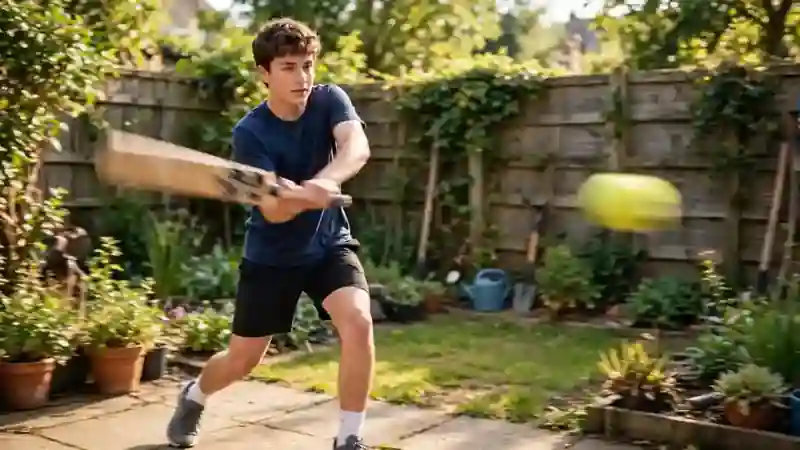
You do not need a cricket academy, a net, or a coach on speed dial to get better at cricket. Some of the most useful training a beginner can do happens in a backyard or driveway — with a tennis ball and a bit of wall. This list is for the absolute beginner who wants to build real skills at home: every drill here needs minimal equipment, can be done solo, and targets something that shows up in real games. I chose them for safety, simplicity, and how directly they transfer to match situations.
1. Shadow batting
Stand in front of a mirror or an open space and play imaginary deliveries — forward defence, drives, cuts, pulls — focusing purely on shape and balance. No ball needed, which means you can do hundreds of repetitions and groove muscle memory without chasing anything. Great for fixing a lazy front shoulder because you can watch yourself. The honest downside: without a real ball, timing does not improve — this builds technique, not hand-eye coordination, so pair it with a ball drill.
2. Wall throwdowns
Throw a tennis ball against a wall and play the rebound as if it were a bowler’s delivery — defend it, drive it, or leave it. The wall never gets tired and gives you a delivery every few seconds, which means enormous repetition in little time. Vary your distance and throw angle to simulate different lengths. The honest downside: rebounds get predictable once you learn the wall, so it stops challenging your reactions after a while — great for grooving shots, limited for developing sharp reflexes.
3. Target bowling at a mark
Place a shoe, a coin, or a taped cross on the ground about a pitch-length away and bowl a tennis ball at it over and over, aiming to land on the mark. This is the single best home drill for bowling accuracy, and accuracy is what gets beginners wickets — raw pace means nothing if you cannot land it. Count how many out of ten hit the target and track it weekly. The honest downside: you cannot practice swing or real bounce at home with a tennis ball, so this builds line and length only, not the fuller bowling craft.
4. Rebound catching off a wall
Throw a tennis ball hard against a wall from a few meters away and catch the rebound cleanly with soft hands. Start with two hands, progress to one hand, then try it with your weaker hand. Fielding is the fastest way for a beginner to become genuinely useful to any team, and catching is its foundation. The honest downside: wall rebounds come back flatter and faster than real cricket catches, so high balls under pressure — the ones that win matches — still need real practice with a partner.
5. Front-foot stride drill
Without a bat or ball, practice stepping decisively toward an imaginary ball — big confident stride, head over the knee, weight into the shot — then resetting. Do it in sets of twenty, alternating the “line” you stride toward. Beginners get out more to poor footwork than to good bowling, and this drill attacks the problem directly. The honest downside: it is boring, and without a ball there is no feedback on whether your stride would actually have met the ball — film yourself occasionally to check your shape honestly.
6. Spin grip and release practice
Sit with a tennis ball and practice your spinner’s grip — fingers across the seam position, wrist cocked — flicking the ball with topspin or sidespin against a wall or into a bucket. Aspiring spinners can build finger strength and release action entirely at home, and the light ball lets you repeat the action hundreds of times without tiring fingers. The honest downside: a tennis ball does not grip and turn like a real cricket ball, so you are training the action, not the actual spin — the real magic only appears with a proper ball on a proper surface.
7. Throw-at-a-target fielding
Set up a single stump, a chair leg, or a taped square on a wall and practice hitting it with throws from increasing distances. Run-ups, pickups, and direct hits are match-winning skills that most beginners never practice because they seem unglamorous. Ten minutes of this a few times a week builds a throwing arm that genuinely intimidates batters. The honest downside: solo throwing does not teach you the pressure of a real run-out situation — the technique transfers, but the composure under pressure has to be learned in games.
8. One-hand pickups on the move
Roll a tennis ball along the ground and practice swooping to pick it up one-handed while moving, staying low and balanced. This mimics the most common fielding action in cricket — the ball will rarely come straight to you in a match. Doing it at walking pace, then jogging pace, builds the coordination that separates tidy fielders from liabilities. The honest downside: without a partner varying the pace and direction, you will groove only the balls you roll yourself — useful, but only half the chaos of real fielding.
9. Balance and stance holds
Get into your batting stance and hold it for 30 seconds, then play a slow-motion cover drive and freeze at the point of contact for 10 seconds. Repeat. It sounds too simple to matter, but balance at the crease is the foundation every shot is built on — beginners who wobble fall over their own feet against real bowling. This drill needs zero equipment and can be done while watching TV. The honest downside: static balance is only the start; dynamic balance against a moving ball is a different skill that needs live practice to develop.
10. Backyard running between the wickets
Mark two creases about 20 meters apart and sprint between them, practicing your turn — bat grounded, low pivot, explosive first three steps. Quick singles win tight games, and run-outs usually happen because of lazy turning, not slow sprinting. This doubles as genuine fitness work. The honest downside: running alone does not teach calling and judgment with a partner, which is where most real run-outs come from — but the physical sharpness absolutely carries over.
What to consider before starting
Start with your weakest area, not your favorite — batters should not skip the catching drills, and bowlers need the fielding work just as much. Keep sessions short: 20–30 focused minutes beats two distracted hours, and daily short sessions build skills far faster than one long weekend session. Safety matters at home — use tennis balls near windows and walls, and clear breakables before you start. If your batting feels stuck, our step-by-step guide to improving your cricket batting technique breaks the whole process down. And if you are wondering whether to train with a tennis ball or step up to a real one, read tennis ball vs leather ball cricket before you decide.
The bottom line
None of these drills will make you a professional, but that was never the goal — they will make you noticeably better than the beginner who only plays on match days, and that gap shows up fast. Pick three drills, do them for twenty minutes a day for a month, and watch what happens. For the bigger picture of the sport, our complete beginner’s guide to understanding cricket explains the game you are training for, and fitness tips for amateur cricket players will keep your body ready.
Keep Reading
- How to Improve Your Cricket Batting Technique: A Step-by-Step Guide for Beginners
- Tennis Ball Cricket vs Leather Ball Cricket: Which One Should You Start With?
- The Complete Beginner’s Guide to Understanding Cricket: Rules, Formats & Fun
- 10 Fitness Tips Every Amateur Cricket Player Should Follow All Season Long