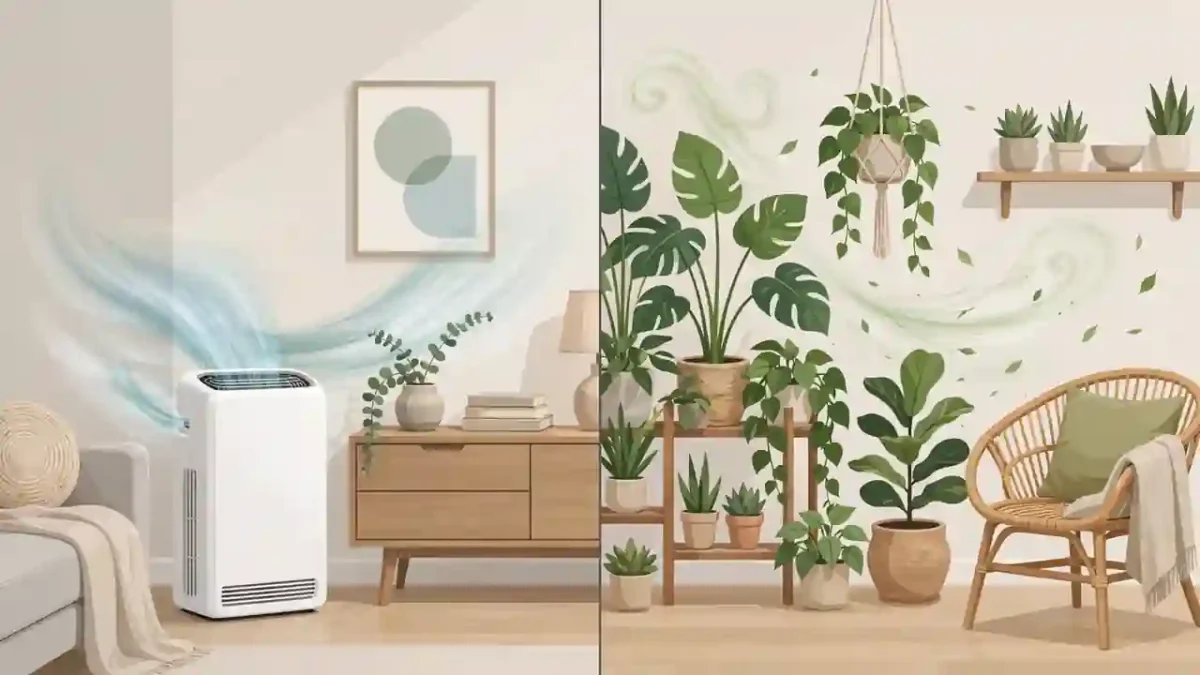
Every winter, as the AQI climbs, two very different products compete for your attention and your wallet: the air purifier, humming in the corner with its HEPA filter, and the humble indoor plant, promising “natural” purification. Social media is full of confident claims on both sides — and most of them are exaggerated. Purifier brands imply their device makes your whole home safe, while plant sellers share graphics claiming a spider plant “removes 90% of toxins.” Both claims collapse under scrutiny, yet both products are genuinely useful once you understand what each actually does. If you are trying to decide where to spend your money for genuinely cleaner indoor air, here is the honest comparison, with each option’s real strengths and the weaknesses its fans prefer not to mention.
The quick verdict
For actually removing pollution particles from your room’s air, a certified air purifier wins by an enormous margin — it is not close. Plants improve how a room feels: they add humidity, look beautiful, and genuinely support wellbeing, but their measurable effect on pollutants in a real room is small. The practical answer for most households is not either-or: run a purifier in the bedroom where you spend eight hours breathing, and keep plants everywhere for the joy of them. Anyone selling you plants as a pollution solution, or a purifier as a wellness lifestyle, is overselling.
| Criteria | Air purifier | Indoor plants |
|---|---|---|
| Removing fine particles (PM2.5) | Excellent — a true HEPA filter captures the vast majority of fine particles in a closed room | Minimal — measurable only in sealed lab chambers, negligible in real rooms |
| Gases, odours, and VOCs | Good with an activated-carbon filter; basic models handle this poorly | Small but real absorption of some gases; far too slow to matter at room scale |
| Upfront cost | Significant — a quality purifier for one room is a real investment; prices vary by brand and room size, so check current prices | Tiny — most plants cost less than a restaurant meal |
| Running cost and maintenance | Ongoing — filter replacements every 6–12 months plus electricity; neglected filters stop working | Near zero — water, light, and occasional repotting |
| Coverage | One room per device — you need the right size for the room, and doors should stay closed | Decorative everywhere, but “coverage” in air-cleaning terms is effectively zero |
| Wellbeing and comfort | White noise and cleaner air help sleep; no visual or emotional benefit | Strong — greenery reduces stress, adds humidity, and makes rooms feel alive |
The honest case for air purifiers
An air purifier with a true HEPA filter does something no plant can: it continuously pulls room air through a dense filter that traps fine particulate matter — the PM2.5 that makes winter air dangerous. In a closed bedroom, a correctly sized purifier can bring particle levels down dramatically within an hour or two, and keep them there all night while you sleep. For households with asthma sufferers, newborns, or elderly members, that is not a luxury — it is the single most effective indoor-air intervention you can buy. If you are shopping, our guide to air purifiers for small apartments explains what to look for before spending.
Now the honest weaknesses. A purifier only cleans the room it is in, with the door closed — it does nothing for the rest of the house, and opening windows defeats it entirely. Filters are a recurring cost that many buyers forget to budget for, and a purifier with a clogged, years-old filter is an expensive fan. Cheaper models often exaggerate their room coverage, so an undersized purifier in a large living room accomplishes little. They also do nothing about humidity or the psychological dreariness of a sealed-up winter home. And no purifier replaces the habit of checking the AQI and ventilating smartly on cleaner days.
The honest case for indoor plants
Plants earn their place honestly once you stop asking them to be machines. A home with greenery feels calmer and more pleasant — that effect is real and well-documented in how people experience spaces. Many popular houseplants add a touch of humidity to dry winter air, which genuinely helps with dry skin and scratchy throats when heaters run. They cost almost nothing, need no electricity, and caring for them is a small daily ritual many people enjoy. Our list of the best indoor plants for homes focuses on varieties that are easy to keep alive in Indian apartments.
The weakness is the central claim. The famous idea that plants “purify air” comes from sealed laboratory chambers, not living rooms — in a real home with doors opening, air leaking, and pollution pouring in, a dozen plants make no measurable difference to particle levels. You would need a jungle — hundreds of plants — to approach what one purifier does, and at that point you have a greenhouse, not a living room. Plants also bring their own small issues: overwatering breeds fungus gnats, soil can mould in damp corners, and several popular varieties are toxic to pets. Love plants for what they are; do not buy them as health equipment.
The myths both sides tell
Two myths deserve a direct debunking because they drive most bad purchases. Myth one: “plants purify your room’s air.” The laboratory studies behind this claim used sealed chambers and measured specific gases over days; your living room exchanges its air with the outdoors constantly, which wipes out the tiny effect. A realistic home would need an impractical forest of plants to match one purifier. Myth two: “a purifier makes indoor air completely safe.” It sharply reduces particles in one closed room — but gases, cooking fumes, and pollution from an open door remain, and the rest of the house is untouched. Neither myth survives contact with how homes actually work. Buy the purifier for particles in one room, buy plants for beauty and comfort, and let each product do its real job instead of the advertised fantasy.
Choose the purifier if… / Choose plants if…
Choose the air purifier if someone in your home has asthma, allergies, or breathing sensitivity; if your city sees long stretches of red or maroon AQI in winter; if you want measurably cleaner air in the bedroom where you spend a third of your life; and if you can commit to replacing filters on schedule. Match the purifier to your room size — an undersized unit is money wasted.
Choose plants if your goal is a more beautiful, calming home; if you want a touch more humidity in dry winter rooms; if you enjoy the hobby of plant care; or if your budget does not stretch to a purifier right now. They are a wonderful addition to any home — just not a pollution strategy.
What about using both?
This is what most thoughtful households end up doing, and it is the best answer. Put a properly sized purifier in the bedroom, run it with the door closed on bad-air days, and maintain its filters. Fill the living areas with plants you love, for the greenery, the humidity, and the simple pleasure of tending something alive. The purifier handles the particles; the plants handle the mood. Together with smart ventilation — windows open on green days, closed on maroon ones — that combination covers everything either option does alone, honestly and without magical thinking.