
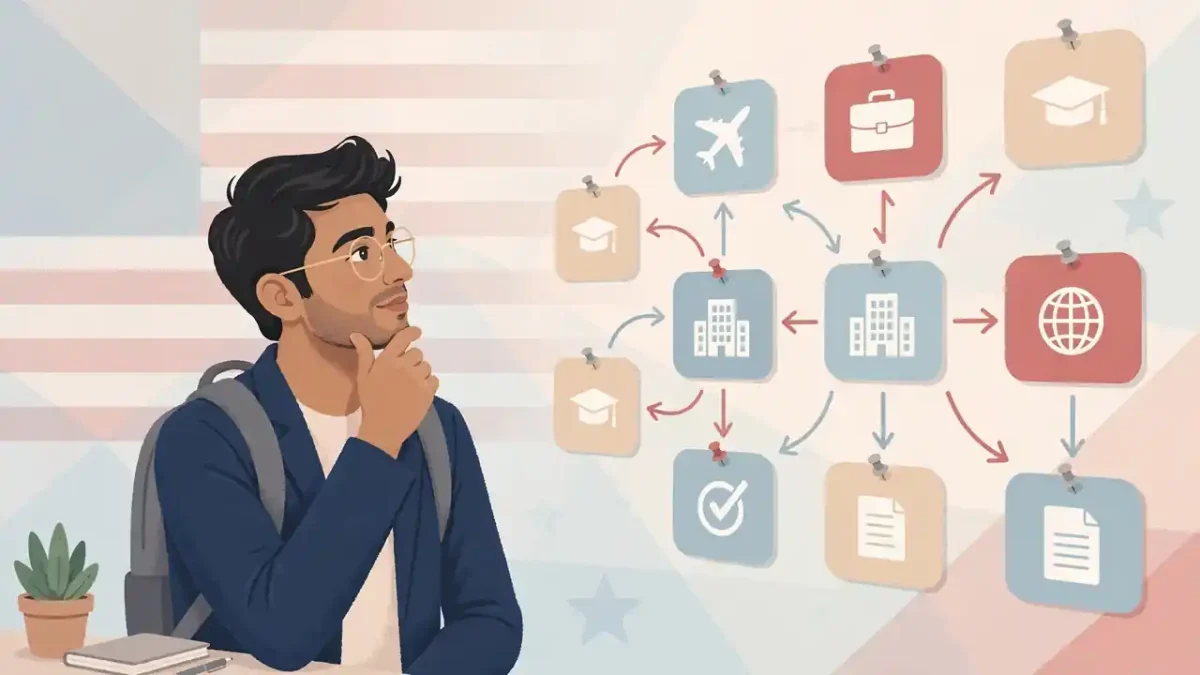
You are a software engineer in Bengaluru, or a data analyst in Pune, or a designer in Hyderabad — and the United States keeps coming up in conversations about careers. The visa system behind those conversations looks like alphabet soup: H-1B, L-1, O-1, J-1, EB-2, EB-3. Everyone seems to know something, nobody seems to know everything, and the recent fee changes added a fresh layer of confusion. This guide starts from absolute zero. No prior knowledge assumed, no jargon unexplained. By the end, you will understand how US work visas actually function, what the main categories are, and what your first real steps should be. Immigration law is complex and changes often, so this guide gives you the map — not legal advice. For decisions about your own case, a qualified immigration attorney is the right next stop after reading.
What a US work visa actually is
Forget the idea of simply “applying for a visa” the way you apply for a tourist visa. US work authorisation is petition-based: in most categories, a US employer files a petition with immigration authorities on your behalf, asking permission to employ you in a specific role. You are the beneficiary; the employer is the petitioner. This single fact shapes everything — your fate depends not just on your qualifications but on finding an employer willing and able to sponsor you. The government then decides whether the petition meets the category’s legal requirements. Understanding this employer-driven structure is the foundation; every category below is a variation on who petitions, for whom, and under what rules.
The main visa categories in plain English
H-1B is the famous one: for professionals in “specialty occupations,” generally requiring a bachelor’s degree or equivalent, with an employer filing for a specific role. It has an annual cap and a lottery. L-1 is for intracompany transfers — employees of multinational firms moving from an overseas office to a US office after about a year with the company. O-1 is for individuals with extraordinary ability, judged on evidence like awards, publications, and press. J-1 covers exchange visitors, including researchers and scholars, often through universities. Beyond temporary visas sit the employment-based green card categories (EB), which grant permanent residency but involve long waits for Indian nationals. Each category has its own rulebook; the names matter less than the mechanics. For the two most compared options, the H-1B vs O-1 comparison goes deeper.
How sponsorship really works
Sponsorship means an employer commits money, paperwork, and legal risk to bring you over. The employer files the petition, pays the filing fees (which rose sharply in the recent fee change), and attests to details about your role and wages. This is why “getting sponsored” is the real bottleneck for most people — not eligibility, but finding an employer who will do this for you. Large tech companies have whole immigration teams; smaller firms may sponsor selectively or not at all. When fees rise, that selectivity sharpens: employers weigh the cost against how hard your skills are to find locally. Your job in this system is to become the candidate worth the paperwork.
The lottery, the cap, and the queue
Three mechanisms shape every timeline. The cap limits how many new H-1Bs are issued each year. The lottery randomly selects which petitions get processed when demand exceeds the cap — merit does not help you here; it is chance. The queue is the green card backlog: for Indian nationals, employment-based green card waits are widely reported to stretch many years, which turns every temporary visa into a long game. Beginners often research only the visa and discover the queue years later. Research all three now, because the queue behind the visa shapes whether a three-year plan is really a fifteen-year plan.
What the fee change means for you
The widely reported H-1B fee hike did not remove the visa — it repriced it. Practically, this means employers now think harder before sponsoring: the cost-benefit calculation shifted, especially for junior roles and smaller companies. For you, the takeaway is twofold. First, your profile needs to justify the spend — scarce skills, strong experience, and clear role fit matter more than ever. Second, this is the moment to learn the alternatives rather than betting everything on one category. The best H-1B alternative routes maps ten options worth knowing, from the L-1 and O-1 to Canada, the UK, and Australia. Diversifying your knowledge is free; diversifying late is expensive.
First steps if you are starting from zero
Start with the official sources: read the USCIS pages for each category that might fit you, and treat everything else as secondary. Next, write down your profile facts — employer type, role, education, experience — and map them honestly against each category’s requirements. Then build the comparison: eligibility, cost, lottery risk, timeline, and backup options. Talk to two or three people who went through the process recently for the practical texture official pages omit. Finally, consult a qualified immigration attorney before committing to a path — one session costs far less than a wrong turn. This step-by-step research method turns these steps into a weekend project. Keep a simple file of everything you learn — links, dates, attorney notes — because visa research done twice is time you will never get back, and rules you read today may shift by the time you act.
Common beginner mistakes
Believing social media over official sources is the classic error — visa outcomes are too important for unverified advice. Next is assuming eligibility equals sponsorship: qualifying for a visa and finding an employer to petition for you are two different battles. Third is ignoring the green card queue until years in. Fourth is treating proposed rule changes as final before they appear on official sites. And fifth is putting every egg in the H-1B basket without learning the alternatives — the fee change taught many professionals this lesson the hard way. Slow, source-checked learning beats fast, confident, wrong learning.
Frequently asked questions
Can I apply for a US work visa by myself? Generally no — most work visa categories require a US employer or agent to file the petition. You cannot simply submit an application on your own.
Do I need a job offer first? For the H-1B, L-1, and most employment routes, yes — a specific offer from a sponsoring employer is the starting point, not the finish line.
How long does the whole process take? It varies enormously by category, employer readiness, and lottery outcomes. Think in terms of many months for a petition, and years if permanent residency is the goal — anyone promising exact timelines is guessing.
What if my H-1B petition is not picked in the lottery? Have backup plans ready before results: alternative visa categories, roles with multinational employers, or strong options in other countries. The best countries for Indian tech professionals beyond the US is a good backup-planning read.
Should I hire an immigration lawyer? For anything beyond basic research, yes — a qualified attorney spots issues in your specific case that no article can. These practical tips for tech workers facing uncertainty also cover the financial steadiness that makes long processes survivable.
Keep Reading
- Best H-1B Alternatives: Work Visa Routes Indians Are Exploring After the Fee Hike
- How to Research US Work Visa Options After the Fee Change, Step by Step
- H-1B vs O-1 Visa: Which Path Fits Skilled Indian Professionals Better?
- 10 Practical Tips for Tech Workers Facing H-1B Uncertainty Right Now (2026)