It’s 7 in the morning. You’re on your usual walk, earbuds in, and a stranger’s voice is keeping you company — explaining exactly how she left her accounting job to sell handmade candles full-time. You laugh at her jokes. You pause to save her supplier’s name. By the time you’re home, you feel like you know her. That bond, built one episode at a time, is the entire business model of podcasting — and one of the most underpriced ways to build an audience that trusts you enough to buy from you.
Here’s what most guides skip: podcasting is a slow-burn income stream, not a lottery ticket. If you need rent money next month, this isn’t it. But give it three to six months of consistent episodes and it becomes an asset that sells your products, fills your client pipeline, and eventually earns ad revenue while you sleep. Below: the honest numbers, the cheapest gear that still sounds professional, a 14-day launch plan, and six income streams real podcasters use.
The Honest Math: What Podcasts Really Earn
The median new podcast earns $0 in its first three months — that’s normal. Income follows audience size, and audiences compound slowly, but the curve bends upward in a way most side hustles don’t.
A show with 1,000 downloads per episode can earn $100–$300 a month from one sponsor (the standard is roughly $18–$25 per 1,000 downloads, called CPM). At 10,000 downloads, that’s $1,000–$2,500 per episode from ads alone, and established shows run two or three ad slots. Add affiliate links, a small digital product, and donations, and a mid-size show can clear $3,000–$5,000 monthly.
But the real money often isn’t ads. Coaches, consultants, and freelancers consistently say their podcast is their best client-acquisition channel — one $2,000 client beats a year of ad revenue. Measure your show in total business impact, not downloads. A hundred loyal listeners who buy beat ten thousand casual ones who don’t.
Your 14-Day Launch Plan: Zero to Published
No studio or perfect voice required — just fourteen days:
- Days 1–2: Pick a narrow lane. “Business podcast” is invisible; “marketing tactics for Etsy sellers” is findable. Write one sentence: who it’s for and what changes for them.
- Days 3–4: Name it and claim it. Include a keyword listeners would actually search — “budget,” “beginner,” your niche. Check Apple Podcasts and Spotify for collisions.
- Days 5–7: Record three episodes, not one. Three episodes give new listeners something to binge. Aim for 20–30 minutes each.
- Days 8–9: Edit lightly. Cut pauses and mistakes; don’t chase perfection. Audacity or Descript (both free) handle this fine.
- Days 10–11: Write titles that sell the click. “Episode 7” tells nobody anything. “How I Got My First 100 Customers With $0” does.
- Days 12–14: Publish and submit everywhere. Upload to a free-tier host (Buzzsprout, Spotify for Creators, Podbean) to get your RSS feed, then submit it to Apple, Spotify, and YouTube.
That’s it — you’re a podcaster.
Gear That Matters (And Gear That Doesn’t)
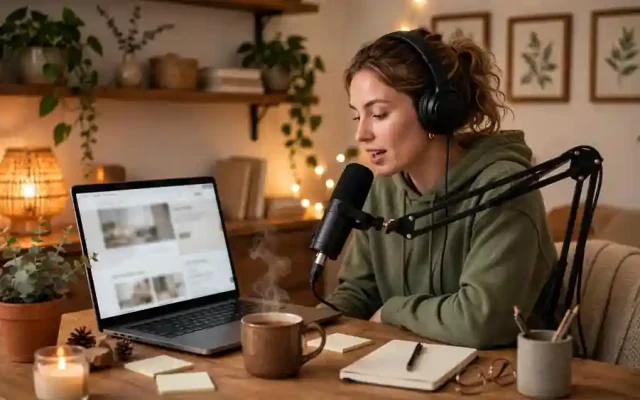
A $60–$100 USB mic (Samson Q2U, Audio-Technica ATR2100x) in a closet full of clothes beats a $400 mic in an echoey kitchen — soft furnishings kill echo.
Minimum viable setup: a decent USB mic, free Audacity, and a phone or laptop — under $100 total, possibly $0. Skip the mixer and acoustic panels until episode 50. What actually upgrades your sound is mic technique: stay 4–6 inches away, speak across the mic (not into it) to soften harsh “p” pops, and record ten seconds of room tone first.
And if you ever need intro narration, ad reads, or trailer voiceovers you can’t record yourself, AI voiceover tools are a legitimate shortcut for short scripted segments — just keep your main episodes in your real voice, because listeners bond with humans.
Six Ways Podcasts Actually Make Money
Forget “get sponsors on day one.” Real podcast income stacks in layers — here are the six streams, in the order they kick in:
1. Your own products and services (month 1+). The fastest money: mention your freelance service, ebook, or course in episodes. Even 200 of the right listeners can produce clients.
2. Affiliate marketing (month 2+). Recommend tools you genuinely use. Software affiliates pay $20–$100+ per signup, so a small loyal audience converts well.
3. Listener support (month 3+). Patreon or Buy Me a Coffee: fans pay $3–$10 monthly for bonus episodes. Typically 1–3% convert — small, but recurring.
4. Sponsorships (month 6+, ~1,000+ downloads/episode). At $18–$25 CPM, a 5,000-download show earns $90–$125 per ad slot. Host-read ads pay most because they perform best.
5. Premium feeds (month 6+). A members-only feed with deep-dives or Q&As. Fifty members at $10/month is $500 of predictable income.
6. Live shows and speaking (year 2+). The long game: an audience makes you bookable, and organizers pay speakers who bring their own crowd.
The first three work with a small audience — you need trust, not fame. That’s why podcasting pairs so well with freelancing: the show is the marketing, and the marketing is the show.
Mistakes That Kill New Podcasts Before Episode 10
Most shows die around episode 7 — from avoidable errors, not lack of talent:
- Inconsistent publishing. Weekly beats “whenever I feel inspired.” Pick a schedule you can sustain for a year and protect it like a client deadline.
- Talking to “everyone.” If an episode could interest anybody, it interests nobody. Name your listener in every outline.
- Skipping promotion. Publishing is 20% of the work. Share clips, guest on other shows, and answer questions where your listeners hang out.
- Recording with no outline. Even five bullet points halve your editing time and keep episodes tight. Rambling is the top reason listeners hit skip.
- Quitting at episode 8. Growth is back-loaded — most shows see first real traction between episodes 20 and 40. Winners are just the ones who didn’t stop.
Who Should Skip Podcasting Entirely
Skip it if you hate delayed rewards, need income this month, or won’t enjoy your topic for 50+ episodes — a faster format like short video may suit you better. And skip it if you won’t promote: the best episode ever recorded earns nothing unheard.
But if you like teaching, can commit to one episode a week for six months, and want an audience that truly trusts you, podcasting has one of the best effort-to-trust ratios of any format. Thirty minutes in someone’s ears builds a buying relationship no 30-second video can match.
Your Questions, Answered
Do I need video?
No — audio-only is the core format and cheaper to produce. But video versions for YouTube can double discoverability, and interview-format episodes hold attention on both.
How long until my first dollar?
Selling your own service or affiliate products: possibly month one — you need the right audience, not a big one. Pure ad revenue: typically 6–12 months of consistent publishing.
Can I podcast in a language other than English?
Absolutely — it’s often an advantage. Non-English podcast markets are far less saturated, making discovery and category ranking easier.
Quick-Start Checklist
- One-sentence show concept (who it’s for + what changes)
- Searchable show name, checked against existing podcasts
- USB mic + quiet recording spot (a closet works)
- Three 20–30 minute episodes recorded and lightly edited
- Click-worthy titles and keyword-rich descriptions
- Host account + RSS feed submitted to Apple, Spotify, YouTube
- One month-one income stream picked (your service, an affiliate, or a digital product)
- Promotion plan: 2–3 places you’ll share every episode, weekly
Start this week — your episode-50 self will thank you for not waiting until everything was perfect.